Best Gym Accessories for Men: A Beginner’s Guide to Home Workouts
Starting a home workout routine can feel oddly complicated when every search result pushes another gadget, app, or “must-have” upgrade. This guide cuts through that noise by matching practical gym accessories for men with beginner advice that works in a small apartment, garage, or spare room. You will see what is worth buying first, what can wait, and how to train safely without turning your space into a crowded mini gym. If you want steady progress without overspending, this is a smart place to begin.
Outline and First Principles for Building a Home Workout Routine
Before comparing equipment, it helps to understand the logic behind a good home setup. Beginners often assume they need many tools, but a useful training space is built around function, not volume. A few versatile accessories can support strength work, mobility, conditioning, and recovery more effectively than a pile of specialized items. For men starting out, the best buying strategy is simple: choose equipment that matches your goals, fits your room, and makes regular training easier rather than more complicated.
This article follows a practical roadmap. First, it identifies the most valuable gym accessories for men who want to train at home. Next, it compares those accessories by budget, available space, and training style. After that, it turns to the beginner experience: how to start, how often to train, and how to avoid the common mistake of doing too much too soon. Finally, it closes with guidance on consistency, recovery, and long-term progress, because equipment matters less than what happens week after week.
Here is the basic outline of what matters most:
- Accessories that improve resistance training, comfort, safety, and progression
- Comparisons between low-cost, mid-range, and more complete home setups
- A beginner-friendly workout structure using limited equipment
- Ways to stay consistent when motivation rises and falls
There is also a wider health context behind this topic. The World Health Organization recommends that adults aim for at least 150 minutes of moderate aerobic activity per week, or 75 minutes of vigorous activity, along with muscle-strengthening activity on two or more days weekly. That does not mean every beginner needs a perfect program on day one. It means home workouts can play a meaningful role in meeting established activity guidelines. A pull-up bar in a doorway, a pair of adjustable dumbbells near a desk, or resistance bands folded into a drawer can quietly remove the biggest barrier of all: convenience.
A home gym does not need to resemble a commercial facility to reshape a routine. In many cases, the smartest setup is the one you can walk to in ten seconds and use without friction. That idea should guide every purchase from this point onward.
The Best Gym Accessories for Men at Home and What Each One Does Well
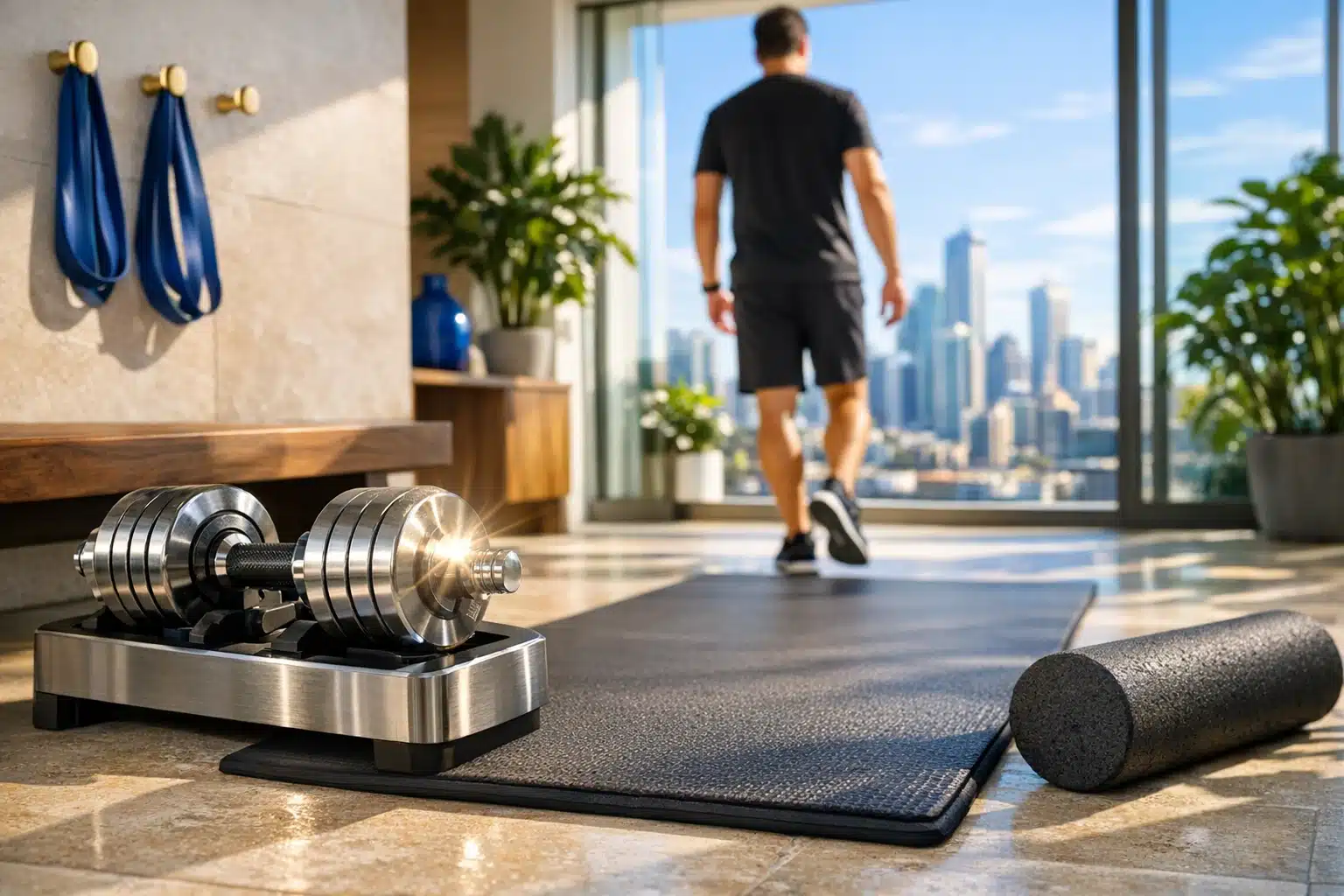
If the goal is usefulness rather than novelty, a handful of accessories consistently stand out. Adjustable dumbbells are near the top of the list because they support presses, rows, squats, lunges, deadlift variations, shoulder work, and carries without taking up the floor space of a full rack of weights. For beginners, they offer room to progress gradually, which matters because strength gains come from repeated overload over time, not from buying more equipment every month. A man training in a bedroom or apartment can do a surprising amount with one adjustable pair and a stable bench or sturdy floor space.
Resistance bands are another strong choice, especially for beginners. They are portable, inexpensive, and versatile enough for rows, presses, glute work, shoulder activation, mobility drills, and warm-ups. Bands also provide accommodating resistance, meaning tension increases as the band stretches. That feature can make simple exercises more challenging without loading joints the same way heavy free weights do. They are not a full replacement for dumbbells or barbells, but they are one of the best value purchases in home fitness.
A quality exercise mat is less glamorous, yet it improves comfort and adherence. Floor-based core work, mobility sessions, stretching, push-ups, and cooldowns feel much better on a supportive surface. If your training space has tile, concrete, or hardwood, a mat reduces impact and helps define a dedicated area. That psychological cue matters more than it sounds. Stepping onto the mat can become the small ritual that tells your brain it is time to train.
Other accessories earn their place based on your goals:
-
Pull-up bar: excellent for upper-body strength, especially back, grip, and arm development
-
Adjustable bench: expands dumbbell training options and improves exercise variety
-
Kettlebell: useful for swings, goblet squats, carries, and conditioning circuits
-
Jump rope: effective for cardio, coordination, and short high-effort sessions
-
Foam roller or massage ball: supports recovery and mobility work
-
Lifting gloves or straps: optional, but helpful for comfort or grip on pulling movements
Not every accessory belongs in the first round of purchases. Ab wheels can be effective, but they are less essential than bands or dumbbells. Wrist wraps, belts, and advanced grip tools are better suited to trainees lifting heavier loads or chasing specific performance goals. Smartwatches and fitness trackers can be useful for monitoring activity, but they are support tools rather than the foundation of a good routine.
For most beginners, the top three priorities are adjustable dumbbells, resistance bands, and a durable mat. Add a pull-up bar if your doorway and bodyweight level allow it, then consider a bench or kettlebell once you have built consistency. The best accessory is not the one with the loudest marketing; it is the one that makes the next workout easier to start and easier to progress.
How to Compare Accessories by Budget, Space, and Training Goals
The phrase “best gym accessories” sounds universal, but the real answer depends on context. A beginner living in a studio apartment has different needs from someone with a garage and a larger budget. The trick is to choose equipment according to limits that are real, not imagined. Space, cost, noise, storage, and training goals all shape what will actually serve you well.
Let us start with budget. A low-cost setup can still be effective if each item covers multiple uses. Resistance bands, a mat, and a jump rope provide mobility work, strength assistance, light resistance, and cardio at a relatively modest price. That package is ideal for the man who wants to build a habit first and upgrade later. A mid-range setup often includes adjustable dumbbells and possibly a doorway pull-up bar. This combination opens the door to much more complete strength training. A higher-budget beginner setup might add an adjustable bench, kettlebell, or compact storage solution, but even then, it should stay focused on versatility.
Space changes the equation too. If you live below neighbors, heavy dropping and loud impact are not smart choices. In that case, bands, dumbbells, slow-tempo bodyweight work, and a mat are more practical than larger metal equipment. If you have a garage or spare room, you may have room for a bench, heavier dumbbells, or a dedicated corner for mobility and strength work. Still, more room does not automatically require more gear. Empty space is useful when you want to move well, stretch, and avoid clutter.
Training goal is the third factor:
-
For general fitness: dumbbells, bands, a mat, and a jump rope cover nearly everything
-
For muscle building: adjustable dumbbells, a bench, and a pull-up bar are especially valuable
-
For fat loss and conditioning: jump rope, kettlebell, bands, and circuits work well
-
For mobility and recovery: mat, bands, foam roller, and light weights make sense
It also helps to think in terms of “cost per useful session.” A cheap accessory you never touch is expensive in practice. A slightly pricier item used three times a week is often the better investment. That is why adjustable dumbbells frequently outrank trend-driven tools. They fit many exercises, many experience levels, and many rooms.
When comparing options, ask three questions. Will this help me train at least twice a week? Can I store it easily? Does it improve more than one kind of exercise? If the answer is yes across the board, you are probably making a smart choice. The home gym market loves complexity, but beginners usually make better progress by choosing a smaller set of dependable tools and learning to use them well.
Home Workout Beginners: A Simple Training Structure That Actually Works
Once the equipment question is handled, the bigger challenge begins: using it consistently. Beginners often bounce between random online workouts, soreness contests, and unrealistic schedules that collapse within two weeks. A better approach is steady, repeatable training built around movement patterns. At home, you do not need dozens of exercises. You need a simple system that covers pushing, pulling, squatting, hinging, core work, and some cardio.
A strong beginner schedule is three full-body sessions per week with at least one rest day between them when possible. This frequency is enough to build skill, improve work capacity, and create a routine without overwhelming recovery. A sample structure could look like this:
-
Day 1: squat, push-up or dumbbell press, row, plank, light cardio
-
Day 2: hinge pattern such as Romanian deadlift, overhead press, band pulldown or pull-up progression, split squat, mobility work
-
Day 3: goblet squat, incline push-up or floor press, one-arm row, glute bridge, jump rope intervals or brisk walking
For most movements, beginners do well with 2 to 3 sets of 8 to 12 repetitions, using a weight or band tension that feels challenging while still allowing good control. The final repetitions should feel like work, but technique should not fall apart. This is where patience pays off. Good form is less dramatic than heroic effort, yet it is what keeps training sustainable.
Warm-ups should be short and purposeful. Five to ten minutes is enough for many people: arm circles, bodyweight squats, hip hinges, band pull-aparts, shoulder rolls, and a minute or two of light cardio. The goal is not exhaustion. It is preparation. After the session, a brief cooldown with easy stretching or walking can help you shift out of training mode.
Progression should also stay simple. Add one of the following when workouts start to feel easier:
-
a small amount of weight
-
1 or 2 extra repetitions per set
-
an additional set
-
slower lowering phases for more control
-
slightly shorter rest periods for conditioning emphasis
Beginners should be careful not to confuse variety with progress. Swapping exercises every session may feel fresh, but repeating core movements is what builds skill and confidence. Push-ups improve because you practice push-ups. Rows improve because you row again next week with a bit more command. There is a quiet satisfaction in this rhythm. The room is the same, the mat is in the same place, the dumbbells wait without ceremony, and your body starts to recognize the routine as normal rather than optional.
One more important point: cardio still matters. Strength work is central, but regular walking, cycling, jogging, or jump rope sessions can support heart health, recovery, and energy balance. If a beginner hates traditional cardio, brisk walks after meals or short rope intervals are perfectly valid starting points. Fitness does not require a dramatic origin story. It usually begins with simple sessions repeated long enough to become part of ordinary life.
Conclusion: The Smartest Home Gym for Men Is the One You Will Keep Using
For men beginning at home, the most effective plan is rarely the most expensive or the most impressive to look at online. It is the plan that fits your room, your schedule, and your current level of fitness. Adjustable dumbbells, resistance bands, a good mat, and perhaps a pull-up bar or bench can cover a huge portion of what a beginner needs. That kind of setup supports strength, mobility, conditioning, and progression without forcing you into a crowded shopping list.
Just as important, your routine should start with restraint. Three sensible sessions per week can be more productive than six chaotic ones. Recovery matters. Sleep matters. Technique matters. Hydration, regular meals, and enough protein can support training, but none of those pieces needs to become obsessive. The goal is not to build a perfect lifestyle by next Monday. The goal is to become the person who keeps showing up.
There are a few common traps worth avoiding:
-
buying advanced accessories before mastering basic movements
-
copying workouts made for experienced lifters
-
chasing soreness instead of tracking progress
-
changing the plan too often
-
expecting visible results before a habit has truly formed
If you stay patient, the benefits begin to stack. Daily movement feels less like a task. Stairs feel easier. Posture improves. Strength in ordinary activities often rises before the mirror shows much change. That is not disappointing; it is encouraging. It means the body is adapting in useful ways.
For the target reader of this guide, the message is straightforward. If you are a beginner, you do not need elite gear or a punishing routine to earn real progress. Choose a few reliable accessories, learn foundational movements, and repeat them with consistency. Let the setup stay simple enough that you never talk yourself out of using it. In the long run, a clear plan, modest equipment, and regular effort will take you much farther than hype ever will.
The best home workout is the one that survives busy weeks, low motivation, and limited space. Build for that reality, and your training has a far better chance of lasting.